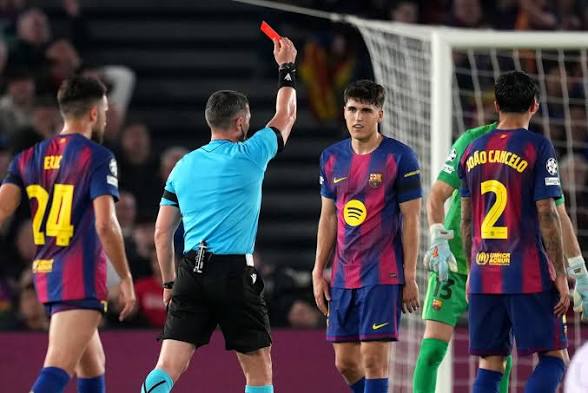
Thierry Henry has strongly challenged the decision to send off Pau Cubarsi during FC Barcelona’s clash with Atletico Madrid in the first leg of the UEFA Champions League quarter finals first leg.
The former striker, reading the game from a tactical lens, believes the referee got it wrong in a moment that ultimately shifted the momentum of the encounter.
Cubarsi was dismissed after a challenge on Giuliano Simeone, with the decision hinging on denial of a clear goalscoring opportunity.
However, as the debate kicks into full swing, Henry insists the situation did not meet the threshold for such a decisive call.
“No, no, no… for me, that’s not a red card. I’m sorry. I understand the rule. Last man, denying a goal-scoring opportunity, but you have to look at the situation,” he said on CBS Sports.”
The ball isn’t completely under control, the angle isn’t perfect, and there’s still distance to the goal. Are we sure he’s going to score? I’m not convinced.
“For me, it’s a yellow card, not a red. Because as soon as you send him off, you change the whole game. And in the Champions League, you have to be 100% sure. I think the referee was too quick to act.”
From a game-management perspective, Henry’s comments highlight how pivotal refereeing calls can tilt elite matches.
Once Barca went a man down, the tactical balance shifted instantly, leaving Hansi Flick with a fresh selection headache ahead of the return leg.
As the tie now rolls into its next phase, Cubarsi’s suspension could prove a major setback, adding further intrigue to what is already shaping up to be a high-stakes European showdown.

Toosin is a dedicated sports writer with a strong background in crafting engaging and insightful content. With experience at Goal, he has developed a sharp editorial sense and a refined storytelling approach that brings depth and perspective to sports journalism. His passion for the game goes beyond the headlines, as he captures both the excitement of the sport and the compelling human narratives behind each event. Toosin’s work resonates with a broad and diverse audience, making global sports stories accessible, relatable, and impactful.