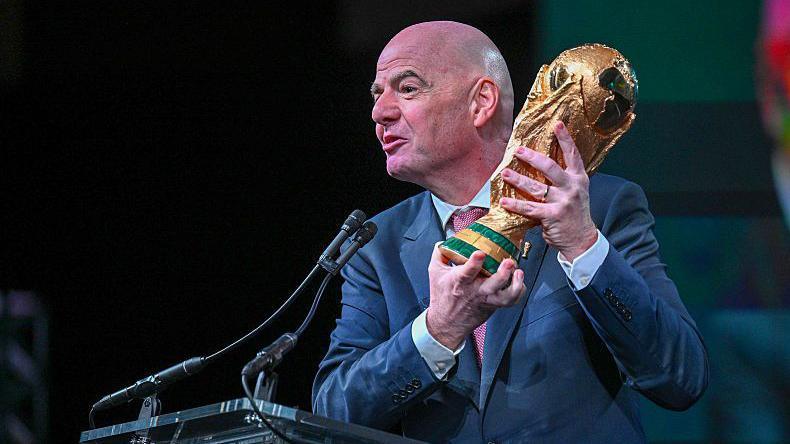
FIFA president Gianni Infantino has confirmed that football’s governing body will consider another major expansion of the FIFA World Cup after the conclusion of the 2026 tournament, with the possibility of increasing the competition to 64 participating nations for the 2030 edition.
The 2026 FIFA World Cup, jointly hosted by the United States, Canada and Mexico, marked the first time the tournament featured 48 teams instead of the traditional 32.
Although the decision initially attracted widespread criticism, the expanded format has largely been praised as the competition has unfolded.
Speaking to Swiss broadcaster Blue Sport, Infantino revealed that discussions surrounding a further expansion are expected once the current World Cup concludes.
“These are all issues that we will be examining after the World Cup.”
While the FIFA president declined to provide further details about the proposal, he reiterated his long-held belief that the World Cup should reflect the global nature of football rather than remain dominated by a handful of traditional powerhouses.
Infantino stressed that expanding the competition is not simply about adding more teams but about creating opportunities for nations across every continent.
According to the FIFA chief, allowing more countries to qualify strengthens football’s global development and gives emerging nations genuine motivation to improve.
“It is important that when you want to organise a World Cup, you do it for the whole world — not just Europe and South America, but effectively the entire world.”
He also argued that every footballing nation deserves the chance to dream of competing on the biggest stage.
“Every nation should be allowed to dream of participating in the World Cup. You can see that the quality of the teams is extremely high and it’s getting higher and higher, all over the world.”
Infantino believes denying smaller nations access to the tournament could ultimately slow the sport’s growth in developing football regions.
“If you don’t give smaller countries a chance to participate in the World Cup, they’ll lack the incentive to keep improving.”
Despite concerns before kick-off that the expanded competition would dilute quality, the 2026 tournament has produced several memorable upsets and competitive matches.
Infantino pointed to the performances of teams from outside football’s traditional elite as evidence that the decision to expand the tournament has been justified.
“Every team played at a high level. Teams from every continent scored goals and earned at least one point.”
He particularly highlighted the impressive showing from African nations, arguing that increased representation has translated directly into improved performances.
“Nine out of 10 African teams reached the knockout stage. At the last World Cup, there were only five teams from Africa. That just goes to show how important it is to include all teams, to give them this opportunity to participate.”
The success of several emerging football nations has added weight to FIFA’s argument that broader participation enhances the overall spectacle rather than weakening it.
The FIFA World Cup expanded from 24 teams to 32 in 1998, a move that has since become widely accepted as one of the tournament’s defining developments.
Now, after introducing the 48-team format in 2026, FIFA is once again considering reshaping the competition’s future.
Should the proposal gain approval, the 2030 FIFA World Cup—scheduled to be co-hosted by Morocco, Portugal and Spain—could become the largest edition in football history with 64 participating nations.
Beyond that, Saudi Arabia is set to host the 2034 tournament, continuing FIFA’s strategy of taking the world’s biggest football event to new regions.
For now, however, Infantino insists no final decision has been made. FIFA’s focus remains firmly on completing a successful 2026 World Cup before evaluating whether another historic expansion is the right step for the global game.
As debates over competition quality, scheduling and player welfare continue, the prospect of a 64-team World Cup is certain to become one of football’s biggest talking points in the years ahead.

Toosin is a dedicated sports writer with a strong background in crafting engaging and insightful content. With experience at Goal, he has developed a sharp editorial sense and a refined storytelling approach that brings depth and perspective to sports journalism. His passion for the game goes beyond the headlines, as he captures both the excitement of the sport and the compelling human narratives behind each event. Toosin’s work resonates with a broad and diverse audience, making global sports stories accessible, relatable, and impactful.