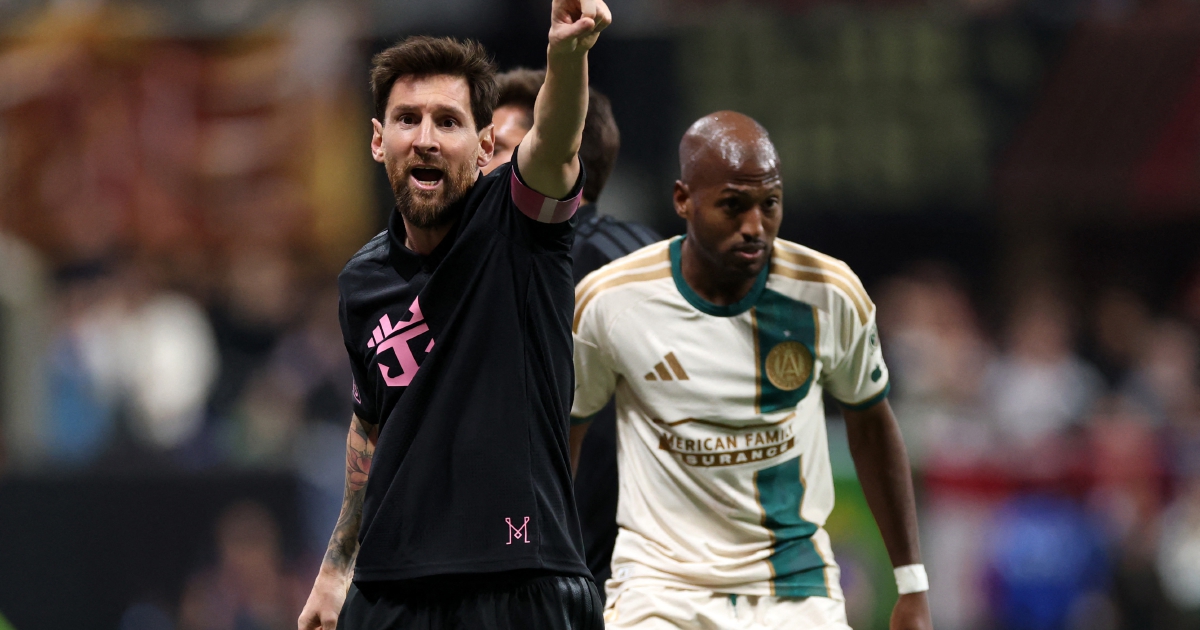

Lionel Messi once again demonstrated why he remains one of football’s most extraordinary talents, leaving D.C. United head coach Rene Weiler searching for answers after Inter Miami’s victory.
D.C. United arrived with a tactical plan designed to neutralise the Argentine superstar, hoping to restrict his movement, deny him space and prevent him from dictating the game. For a while, their approach appeared to be working. But Messi had other ideas.
The eight-time Ballon d’Or winner turned the contest on its head after the break, scoring twice and coming close to completing a hat-trick, only for the woodwork to deny him a third goal.
For Weiler, the second-half performance was difficult to comprehend, particularly after his team had successfully limited Messi’s influence during the opening period.
“Honestly, I don’t think I will ever understand this man. We came into this game with a plan specifically designed to limit [Lionel] Messi. We put enough players around him, closed the spaces he likes to exploit, and made sure he couldn’t receive the ball comfortably. At some point, I genuinely thought we had figured him out.
“The first half was a success. We knew we were dealing with a special player, so we prepared for every possible situation. We wanted to make his evening as difficult as possible, and for a while, our plan was working.
“But the second half? I honestly have no explanation for what I witnessed. Messi became unstoppable. He scored twice, and the woodwork denied him the chance to complete a hat-trick. I was standing there wondering what more we could possibly do.
“And this is the part I still cannot understand.
“Is this not the same man who recently said goodbye to international football because his legs could no longer give him everything he wanted?
“I heard those words, and now I have watched him dominate a game like this. It makes you wonder whether age even means anything to him.
“My players spent the entire second half chasing him. We tried to close him down, double up on him, and take away his space, but he kept finding a way out.
“Every time we thought we had him under control, he escaped.
“Every time we sent another player to help, he found a pass nobody else could see.
“As a coach, you spend hours studying opponents, preparing your players, and searching for solutions. But sometimes, you face a player who makes all that preparation look meaningless. Messi can make you question everything you thought you knew about football.
“I respect Inter Miami, and they deserved their victory. But tonight, I have to be honest with you.
We didn’t just lose to Inter Miami. We lost to the greatest of all time [Lionel Messi].”
Weiler’s reaction captured the frustration of facing a player capable of changing a match even when opponents believe they have successfully contained him.
D.C. United’s first-half discipline suggested their strategy could frustrate Inter Miami. By crowding Messi’s areas of influence and limiting his opportunities to receive the ball in dangerous positions, they appeared to have found a way to disrupt his rhythm.
However, containing Messi for 45 minutes is one challenge; sustaining that control throughout an entire match is another. The Argentine’s two-goal contribution after the interval exposed the difficulty of maintaining a defensive plan against a player whose vision, movement and decision-making can unlock even the tightest spaces.
His ability to escape pressure and find passing options also forced D.C. United to reconsider their approach as the game progressed. Every additional defender committed to stopping him risked creating opportunities for his teammates elsewhere on the pitch.
For Inter Miami, Messi’s display underlined his continuing importance to the team’s attacking ambitions. His influence extends beyond goals, with his creativity and ability to manipulate defensive structures making him a constant threat.
Weiler ultimately acknowledged that his side had been beaten by a player whose individual brilliance proved decisive. While D.C. United may take lessons from their first-half performance, stopping Messi for the full 90 minutes remains a challenge that even carefully prepared opponents can struggle to solve.
For the Argentine, the performance provided another reminder that his influence on the game remains formidable, with age doing little to diminish his ability to produce moments that leave opponents searching for explanations.

Toosin is a dedicated sports writer with a strong background in crafting engaging and insightful content. With experience at Goal, he has developed a sharp editorial sense and a refined storytelling approach that brings depth and perspective to sports journalism. His passion for the game goes beyond the headlines, as he captures both the excitement of the sport and the compelling human narratives behind each event. Toosin’s work resonates with a broad and diverse audience, making global sports stories accessible, relatable, and impactful.