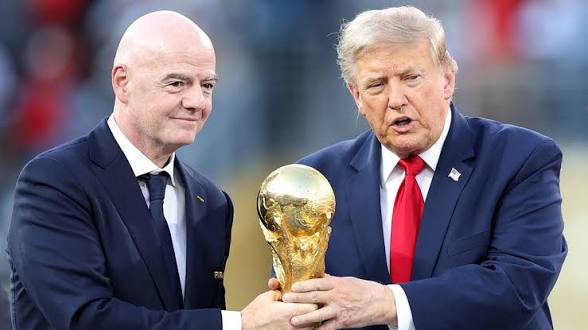
The International Olympic Committee (IOC) has ruled that it will not investigate FIFA president Gianni Infantino over allegations that he breached Olympic rules on political neutrality through his relationship with United States President Donald Trump.
The decision brings an end—at least from the IOC’s perspective—to a complaint submitted by human rights organization FairSquare, which argued that Infantino’s actions raised serious governance and ethical concerns during the 2026 FIFA World Cup.
Although Infantino remains a member of the IOC, the Olympic body concluded that the allegations relate solely to FIFA’s internal governance and decision-making processes, placing the matter outside its legal and ethical jurisdiction.
The outcome means any further examination of the allegations will remain within FIFA’s own structures rather than under Olympic oversight.
FairSquare lodged the complaint earlier this month after questioning FIFA’s handling of disciplinary matters during the World Cup.
One of the key issues involved United States striker Folarin Balogun, whose automatic suspension following a red card was deferred after President Donald Trump reportedly asked Infantino to review the decision.
The controversy intensified after Trump publicly disclosed that he had personally spoken with the FIFA president regarding the incident.
Critics argued that political influence should never intersect with disciplinary matters at football’s biggest tournament, prompting calls for an independent investigation into whether FIFA’s neutrality had been compromised.
Following a review of the complaint, the IOC Ethics Commission determined that it did not possess the authority to investigate the allegations because they concerned FIFA’s governance rather than its relationship with the Olympic Movement.
“The IOC ethics commission thoroughly analysed the complaint by FairSquare,” explained a spokesperson for the IOC.
“The commission noticed that, pursuant to the Olympic Charter, each international federation (IF) maintains its independence and autonomy in its governance.
“The IOC Code of Ethics’ scope of application vis-a-vis the international federations and their officials is specifically limited to their relations with the IOC.”
The statement continued: “The IOC ethics commission noted that the current complaint, including with regard to the FIFA president, refers only to the IF’s decisions on its governance and its management, including its relations with government, and to the IF’s implementation of the rules of its sport, which are both outside the scope of application of the IOC code of ethics.
“Consequently, the complaint falls outside the IOC ethics commission’s jurisdiction. FairSquare has been informed accordingly.”
Despite dismissing the complaint, the IOC reaffirmed its commitment to improving governance standards across international sport.
“Separately from this complaint, as reaffirmed at the recent IOC Session, the IOC will continue its efforts to strengthen good governance across the Olympic Movement and to promote greater clarity regarding the respective roles, responsibilities and accountability of its constituent organisations.”
Although the IOC has closed its involvement, the issue remains active elsewhere.
FairSquare previously submitted a separate complaint to FIFA’s Ethics Committee in December, requesting an investigation into several instances where Infantino allegedly expressed public support for Trump and his policies.
That complaint also questioned FIFA’s decision to create a FIFA Peace Prize and award its inaugural honour to Trump during the 2026 FIFA World Cup draw, raising concerns over whether the process complied with FIFA’s own governance rules.
According to FairSquare, FIFA acknowledged receipt of the complaint but has yet to provide any substantive update on its progress.
Notably, the ethics complaint was submitted before the controversy surrounding Balogun’s suspension emerged.
The Balogun incident remains one of the most debated controversies of the 2026 FIFA World Cup.
FIFA’s Disciplinary Committee announced on July 5 that the Monaco forward’s automatic one-match suspension had been deferred, allowing him to remain available.
A day later, Trump revealed he had personally appealed to Infantino regarding the sanction.Infantino has consistently insisted that FIFA’s judicial and disciplinary bodies operate independently and without presidential interference.
However, FIFA has not publicly explained why Balogun’s suspension was postponed, leaving many questions unanswered.
Reports have suggested that Disciplinary Committee chairman Mohammad Al Kamali made the decision independently, though no official clarification has been issued.
The controversy has also widened the growing tension between FIFA and UEFA.UEFA previously described the Balogun ruling as “unprecedented, incomprehensible and unjustifiable,” while reports indicated that UEFA president Aleksander Ceferin chose to boycott the 2026 FIFA World Cup final as a sign of dissatisfaction with FIFA’s governance.
The disagreement has fuelled broader debates surrounding transparency, accountability and political influence within football’s governing institutions.
While the IOC has formally stepped away from the matter, the broader questions surrounding FIFA’s governance remain unresolved.
With FairSquare’s complaint still awaiting progress inside FIFA’s Ethics Committee and continued scrutiny from UEFA and other stakeholders, Gianni Infantino’s leadership is likely to remain under the spotlight.
For now, however, the IOC has made its position clear: the allegations concern FIFA’s internal affairs, and as such, they fall beyond the Olympic body’s authority to investigate.

Toosin is a dedicated sports writer with a strong background in crafting engaging and insightful content. With experience at Goal, he has developed a sharp editorial sense and a refined storytelling approach that brings depth and perspective to sports journalism. His passion for the game goes beyond the headlines, as he captures both the excitement of the sport and the compelling human narratives behind each event. Toosin’s work resonates with a broad and diverse audience, making global sports stories accessible, relatable, and impactful.