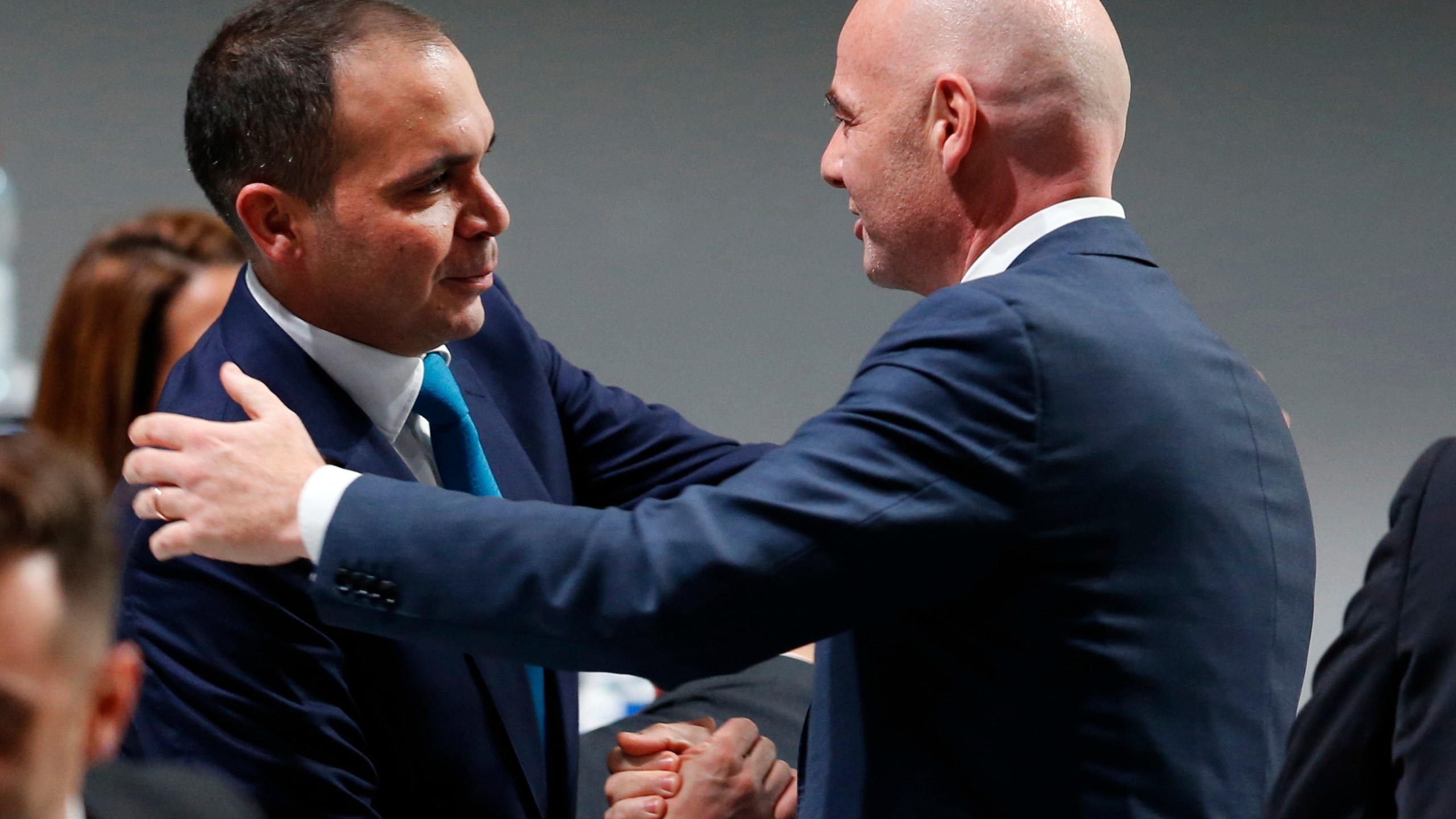
FIFA president Gianni Infantino is facing fresh scrutiny after former FIFA vice president Prince Ali bin Al Hussein publicly accused the world football governing body of using financial pressure to influence political support.
The Jordanian royal claimed that prize money owed to the Jordan Football Association for reaching the final of the 2025 FIFA Arab Cup has yet to be paid, while alleging that support for Infantino’s leadership was subtly linked to resolving the issue.
The latest accusation adds another layer to the growing crisis surrounding FIFA’s leadership following the collapse of the controversial FIFA Forward Enterprise (FFE) proposal, which triggered widespread opposition from confederations, national associations and senior football officials across the globe.
Prince Ali, who currently leads the Jordan Football Association and previously served as a FIFA vice president, revealed the claims in a strongly-worded social media statement.
According to the Jordanian royal, discussions during the recent FIFA World Cup suggested that publicly backing Infantino’s presidency could improve the relationship between FIFA and Jordan’s football federation.
Rather than accepting such an arrangement, Prince Ali insisted Jordan would remain committed to its principles.
“We pride ourselves in Jordan in upholding ethical values. We did not endorse him before and certainly will not now,” said Prince Ali, who placed third in a five-candidate FIFA presidential contest when Infantino was first elected in February 2016.
He went even further with his criticism.
“But the whole situation amounts to blackmail and we refuse to give in to that,” the Jordanian royal wrote Tuesday.
At the centre of the dispute is the prize money Jordan believes it is still owed after reaching the final of the 2025 FIFA Arab Cup in Qatar.
Jordan finished runners-up after losing the final to Morocco, with reports indicating the federation was due approximately $4.2 million in prize money.
Prince Ali questioned why the payment remains outstanding despite FIFA’s significant financial reserves.
“The money our team should receive for having reached the final has not been delivered yet,” Prince Ali wrote, “while at the same time FIFA brags about how many billions they have in reserve.”
He continued by pointing directly at FIFA’s leadership.
“It is clear the problem really is with leadership. For months, FIFA has been refusing to help us on any of these or other matters,” he said.
FIFA has yet to publicly respond to the allegations.
The controversy comes at an especially sensitive time for Infantino.
Only days ago, FIFA abandoned its proposal to sell minority stakes in future World Cup commercial rights after fierce resistance from UEFA, Concacaf and the Asian Football Confederation (AFC).
The proposal would have seen private investors led by Joshua Kushner’s Thrive Eternal fund invest billions into a new commercial structure overseeing FIFA competitions.
The failed project has already triggered resignations within FIFA, growing calls for governance reform and increasing discussion over Infantino’s political future.
Despite previously appearing certain to secure another term, Infantino now faces growing uncertainty ahead of FIFA’s presidential election.
Candidate declarations are expected before November 18, while FIFA’s 211 member associations will vote during the FIFA Congress in Rabat, Morocco, on March 18.
Asia could emerge as the decisive battleground in any contested election.
While UEFA, Concacaf and several influential football figures have openly questioned Infantino’s leadership following recent events, Africa, South America and Oceania are widely expected to remain supportive unless further political momentum shifts.
Prince Ali is no stranger to challenging FIFA leadership.
The Jordanian royal unsuccessfully contested Sepp Blatter’s presidency in 2015 before finishing third when Infantino won the FIFA presidency in 2016.
Prince Ali’s latest intervention reflects a broader concern spreading throughout world football regarding transparency, governance and accountability inside FIFA.
Whether the governing body responds publicly to the allegations or not, the controversy further intensifies pressure on Infantino at a time when confidence in FIFA’s leadership is already under unprecedented strain.
With presidential elections approaching and football’s global power brokers increasingly divided, the debate surrounding FIFA’s future leadership appears far from over.

Toosin is a dedicated sports writer with a strong background in crafting engaging and insightful content. With experience at Goal, he has developed a sharp editorial sense and a refined storytelling approach that brings depth and perspective to sports journalism. His passion for the game goes beyond the headlines, as he captures both the excitement of the sport and the compelling human narratives behind each event. Toosin’s work resonates with a broad and diverse audience, making global sports stories accessible, relatable, and impactful.