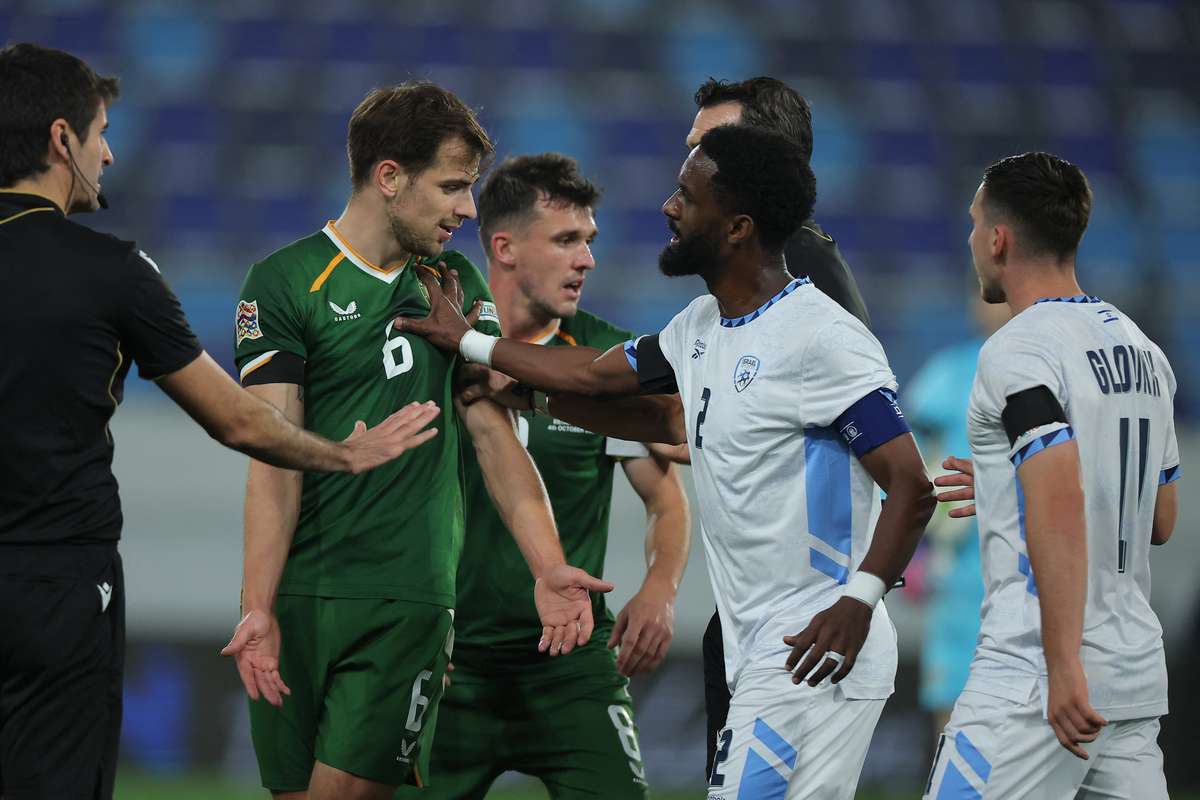
UEFA has launched an investigation into possible misconduct involving the Republic of Ireland and Israel following their tense Nations League encounter in Serbia.
The European governing body confirmed on Tuesday that it had appointed an ethics and disciplinary inspector after official reports raised an allegation concerning an incident around the tunnel at half-time.
UEFA did not immediately reveal further details, but the development adds another layer to an already highly charged fixture that ended 1-1 in neutral Backa Topola.
The Irish Times previously reported that Ireland’s head of athletic performance, Damien Doyle, alleged that an Israel player spat at him as both teams headed towards the tunnel at the interval.
Ireland manager Heimir Hallgrimsson had already claimed after the match that Israel’s players attempted to intimidate his side from the opening stages.
The latest confrontation comes against an intensely political backdrop. Ireland defeated Israel 3-0 in their first Nations League meeting on September 27 in Debrecen, Hungary, before the two sides met again in Serbia.
Ireland’s players wore black armbands for Sunday’s encounter, bowed their heads during Israel’s national anthem and refused to shake hands with their opponents as a protest against Israel’s actions in Gaza.
Israel’s players also wore black armbands, but in remembrance of people killed during the Hamas-led attacks on Israel on October 7, 2023.
Tensions had already spilled into the build-up to the match. During Saturday’s pre-match news conference, an Israeli journalist claimed that Irish players had called their opponents “monkeys” during the first meeting.
Ireland communications officer Kieran Crowley immediately rejected the allegation, calling it “a lie” before bringing the news conference to an end.
The fixture itself had been surrounded by controversy long before kick-off. The match was originally scheduled to take place in Dublin, but the Football Association of Ireland moved it to neutral Serbia in June, citing “operational reasons”.
The decision followed widespread calls for Ireland to boycott the fixture because of the ongoing conflict.
The FAI resisted those calls, warning that refusing to fulfil the fixture could expose Ireland to serious UEFA sanctions.
Now, UEFA’s investigation could determine whether further disciplinary action is required following the latest flashpoint.
The governing body’s probe means the Ireland-Israel rivalry could remain in the spotlight beyond the pitch, with official reports set to form the basis of any potential disciplinary decisions.
The situation also carries wider significance for Irish football, with Ireland set to co-host the 2028 European Championship alongside England, Wales and Scotland.
For now, UEFA has provided no indication of what sanctions, if any, could follow. The investigation will have to establish exactly what happened around the tunnel before any disciplinary conclusions are reached.

Toosin is a dedicated sports writer with a strong background in crafting engaging and insightful content. With experience at Goal, he has developed a sharp editorial sense and a refined storytelling approach that brings depth and perspective to sports journalism. His passion for the game goes beyond the headlines, as he captures both the excitement of the sport and the compelling human narratives behind each event. Toosin’s work resonates with a broad and diverse audience, making global sports stories accessible, relatable, and impactful.