Former Chelsea team doctor Eva Carneiro has reignited one of the most controversial episodes of Jose Mourinho’s Chelsea reign after responding to comments made by the Portuguese manager and John Terry in a new Netflix documentary.
The dispute dates back 11 years, but Mourinho’s documentary has brought the explosive 2015 incident back into the spotlight.
Carneiro was responding after Mourinho and former Blues captain Terry revisited the confrontation involving the club’s medical team during a Premier League match against Swansea City in August 2015.
“11 years on and here we are reliving the worst. Hope they made some money,” she responded bluntly.
The controversy erupted during the closing stages of Chelsea’s 2-2 draw with Swansea at Stamford Bridge.
Chelsea goalkeeper Thibaut Courtois had already been sent off when Eden Hazard went down and required medical attention.
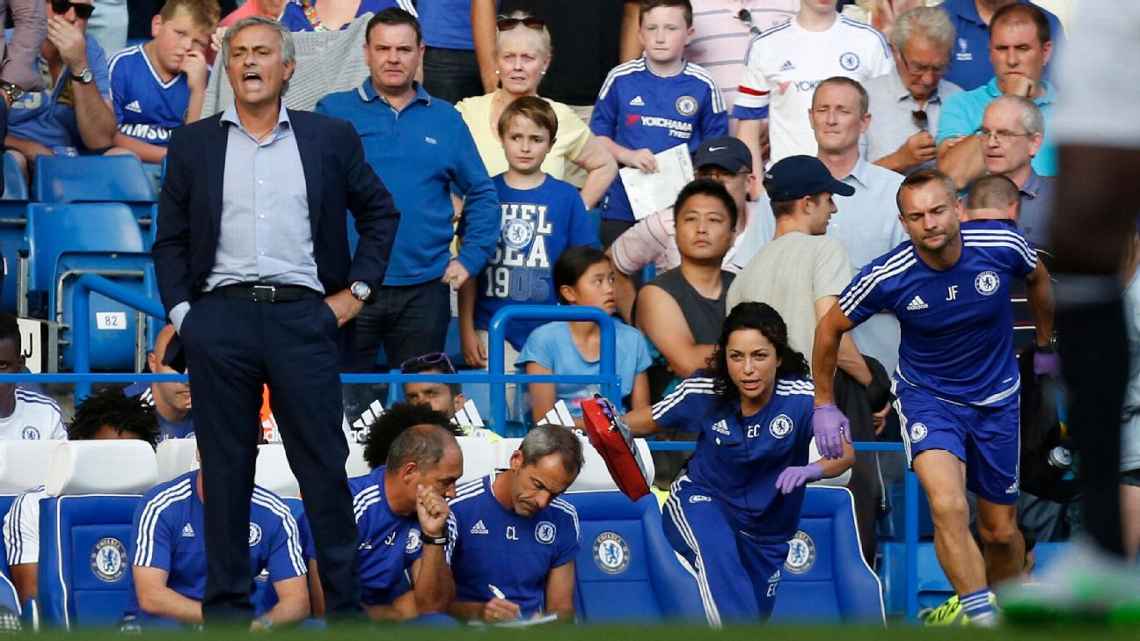
Carneiro and first-team physiotherapist Jon Fearn entered the pitch to treat the Belgian forward after referee Michael Oliver called the medical staff onto the field.
Because Hazard had to leave the pitch while receiving treatment, Chelsea were temporarily reduced to nine players. Mourinho was furious.
The then-Chelsea manager subsequently criticised Carneiro and Fearn, describing them as “impulsive and naive” and claiming they did not “understand the game.”
More than a decade later, Mourinho offered his perspective again in the documentary.
“I’m not a doctor but my eyes know when a player is injured and when a player is not injured.
“I knew Eden was not injured but the doctors went on to the pitch and we were left with nine players.
“For me, a lady doctor is the same as a man doctor. So, as always, I used my vocabulary when I’m not happy.
“There are words in moments where the tension is very, very high.
“Normally, people with football culture, with football DNA or with a football background get over it in one second. In that case, it was different.”
Terry, who was Chelsea captain at the time, also discussed the incident in the documentary and supported Mourinho’s account of the understanding between the coaching staff, players and medical department.
“Medically, Jose would say unless it’s really, really bad, then they’re not coming on,” Terry said.
“That was the understanding of us as players, the medical staff, everyone bought into that.
“It was a big moment obviously and he took a lot of backlash for that.”
Carneiro strongly rejected the suggestion that she should have ignored the situation.
“We are bound by a medico-legal code of conduct,” Carneiro wrote. “Genuinely it would be healthy for John Terry to learn the rules of the game. It’s been long enough mate,” she wrote responding to Terry directly.
The former Chelsea doctor also shared a statement from the British Association of Sport and Exercise Medicine, which emphasised that medical professionals have an “absolute duty of care” to assess a player when requested to do so by the referee.
Carneiro then provided her own account of what happened, insisting that the medical team had no choice once the referee and player requested assistance.
“So IT IS really simple. Referee Michael Oliver called us on TWICE, player Eden Hazard requested medical assistance we then made eye contact from side line and he confirmed he needed medical assistance, TWICE.
“At that point my hands are bound as a medical professional.”
That explanation goes to the heart of the dispute.
While Mourinho viewed the decision through the tactical consequences of Chelsea temporarily having nine players, Carneiro’s argument is that her professional responsibilities took precedence once medical assistance was requested.
The Swansea incident had major consequences for Carneiro.
She and Fearn were removed from first-team duties following the match, while Carneiro left Chelsea the following month.
She subsequently launched legal proceedings against the club for constructive dismissal and brought a separate claim against Mourinho.
Chelsea and Carneiro reached a settlement in June 2016 after the dispute reached an employment tribunal.
The club apologised to Carneiro, although Mourinho never publicly issued an apology.
Mourinho was also cleared by the Football Association in September 2015 of making discriminatory comments towards Carneiro during the incident.
Less than three months later, Chelsea dismissed Mourinho following a disastrous start to their Premier League title defence.
The passage of time has done little to erase the controversy.
Mourinho’s documentary has once again placed the incident under the microscope, but Carneiro’s response shows that the episode remains deeply personal for the former Chelsea medical professional.
At the centre of the disagreement are two very different interpretations of the same moment: one based on footballing consequences and another grounded in medical responsibility.
For Carneiro, the issue is straightforward. A referee called for medical assistance, Hazard indicated that he needed treatment, and the medical team responded.
Eleven years on, that remains her defence — and her latest response ensures the Chelsea controversy is far from forgotten.

Toosin is a dedicated sports writer with a strong background in crafting engaging and insightful content. With experience at Goal, he has developed a sharp editorial sense and a refined storytelling approach that brings depth and perspective to sports journalism. His passion for the game goes beyond the headlines, as he captures both the excitement of the sport and the compelling human narratives behind each event. Toosin’s work resonates with a broad and diverse audience, making global sports stories accessible, relatable, and impactful.