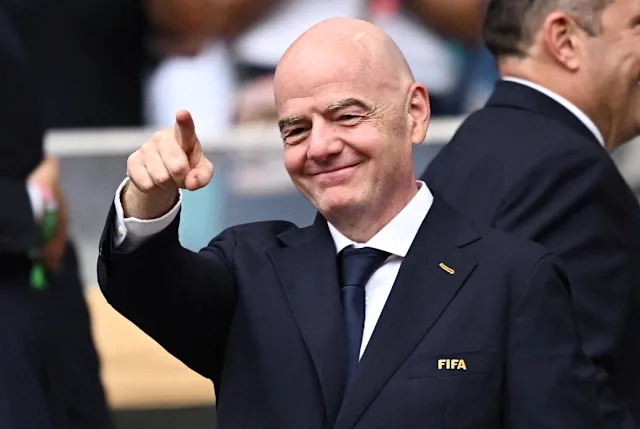
FIFA president Gianni Infantino has intensified efforts to push through one of the most ambitious financial reforms in football history, giving the organization’s 211 member associations until September 19 to decide whether they will support a proposal to open part of FIFA’s commercial business to private investors.
The controversial plan, unveiled earlier this week, centres on the creation of FIFA Forward Enterprise (FFE)—a new commercial entity that would manage the governing body’s broadcasting rights, sponsorship deals, ticketing operations, licensing agreements and the delivery of major international tournaments, including the FIFA World Cup.
If approved, FIFA intends to sell minority, non-controlling stakes in FFE to external investors.
The governing body believes the new company could be valued at approximately $20 billion, with the sale expected to generate as much as $4.2bn (£3.1bn) in fresh investment.
While FIFA insists the proposal is designed to strengthen football’s financial future, it has already attracted significant criticism from several quarters, particularly UEFA, which has questioned whether football’s governance should become tied to private investment.
In a letter sent exclusively to FIFA’s member associations following the leak of the proposal, Infantino attempted to strengthen support by outlining the financial benefits available to countries that approve the project.
The FIFA president revealed that associations backing the proposal before the September deadline would become eligible for enhanced football development funding from January 1, 2027.
Initially, FIFA indicated participating associations could receive around $20m (£15m) between 2027 and 2030.
However, Infantino’s latest correspondence doubles that figure, raising the potential allocation to $40m (£30.1m).The move is widely viewed as an attempt to secure enough backing before the proposal is formally presented for approval.
“A singular and unique funding opportunity only for those Member Associations who wish to participate, with their decision to be made by September 19 2026 so we can plan ahead and with funds to be available immediately as of January 1 2027,” Infantino wrote.
“This entity will be fully focused on one target objective; generating as much value as possible for FIFA’s Member Associations.”
Despite the financial incentives, the proposal cannot proceed without broad support from football’s global membership.
FIFA’s statutes require the project to receive backing from more than 50 per cent of its member associations, in addition to approval from the FIFA Council.
That vote is expected to become one of the most significant governance decisions in recent football history, with supporters arguing it will unlock unprecedented financial resources for developing football worldwide.
Critics, however, fear commercial interests could gradually gain greater influence over the governance and direction of the sport.
Although FIFA has outlined the potential financial benefits, several aspects of the proposal remain unclear.
The governing body has yet to explain how external investors would influence the operation of FIFA Forward Enterprise over time or what safeguards would exist to protect football’s independence.
Equally, questions continue to be asked about the long-term governance of the new commercial vehicle and how future revenues would be distributed beyond the initial development funding promises.
There is also continued scrutiny surrounding Infantino’s own future. While FIFA insists FFE is designed purely to maximise commercial value for its members, the organization has not commented on suggestions regarding whether the success of the project could strengthen Infantino’s influence beyond 2031, when current presidential term limits are expected to end his tenure if he secures another mandate.
The September 19 deadline now places football associations under significant pressure to decide whether to embrace one of the biggest structural changes FIFA has proposed in decades.
Supporters see the initiative as an opportunity to generate billions in new revenue for football development across every continent.
Opponents, meanwhile, believe the governing body risks commercializing the game’s most valuable competitions in ways that could reshape football permanently.
As debate intensifies across the global football community, the outcome of the vote could determine not only FIFA’s financial future but also the balance between commercial growth and sporting governance for years to come.

Toosin is a dedicated sports writer with a strong background in crafting engaging and insightful content. With experience at Goal, he has developed a sharp editorial sense and a refined storytelling approach that brings depth and perspective to sports journalism. His passion for the game goes beyond the headlines, as he captures both the excitement of the sport and the compelling human narratives behind each event. Toosin’s work resonates with a broad and diverse audience, making global sports stories accessible, relatable, and impactful.