
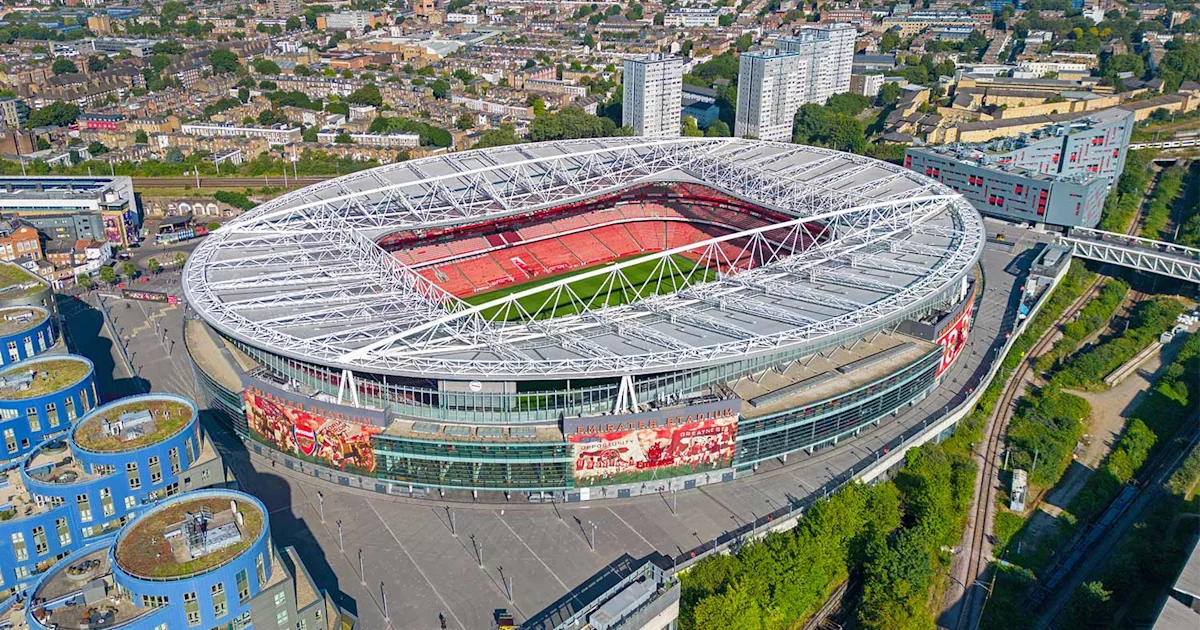
Arsenal have decided against a major expansion of the Emirates Stadium, ending speculation that the north London club could significantly increase its current 60,704 capacity.
The decision follows a review launched in 2024, when Arsenal established a working group led by chief executive Richard Garlick to explore the possibility of carrying out extensive redevelopment at their home ground.
Instead of pursuing a large-scale project, the club have opted for what they describe as the “continued evolution” of the Emirates.
That approach will focus on improving the experience for supporters rather than dramatically increasing the number of seats available. Hospitality, retail, visitor facilities, catering and other matchday services are expected to remain key areas of investment.
Arsenal confirmed the decision during a meeting with supporters, explaining that smaller improvements would be prioritised over a major stadium masterplan.
“We shared a commitment to the continued evolution of Emirates Stadium, rather than a huge-scale masterplan, building on improvement we have made to date in partnership with our catering partner, Legends, the introduction of safe standing (this season in the Clock End, and next season in the North Bank), improving hospitality and retail experiences, and upgrading visitor experiences,” Arsenal said in a statement.
The decision comes despite the Emirates regularly operating at maximum capacity for Arsenal home matches.
At 60,704 seats, the stadium is already one of England’s largest football grounds, but it remains smaller than several of its Premier League rivals.
Tottenham Hotspur Stadium, which opened in 2019, holds 62,850 spectators and was specifically designed as a multi-purpose venue capable of hosting football, NFL games and major concerts.
Arsenal’s Emirates is currently England’s seventh-largest football stadium by capacity. Only Wembley Stadium, Old Trafford, Tottenham Hotspur Stadium, the London Stadium, the Etihad Stadium and the expanded Anfield can accommodate more supporters.
A significant expansion would also have presented Arsenal with a major logistical challenge.
Extensive construction work could have forced the club to relocate some designated home fixtures to another stadium while the redevelopment was taking place. That disruption, combined with the scale and cost of a major expansion, appears to have influenced the club’s decision to pursue a less ambitious route.
The Emirates has been Arsenal’s home since 2006, when the club left Highbury after more than nine decades at the historic north London ground.
However, the move to the Emirates was not the only stadium option Arsenal considered.
In the late 1990s, the club experimented with moving Champions League fixtures to Wembley in an attempt to give more supporters the opportunity to watch the team.
Wembley could accommodate roughly twice as many spectators as Highbury, which had a capacity of 38,419 at the time.
The experiment, however, did little to strengthen the case for permanently playing major fixtures away from Highbury.
Arsenal won only two of their six matches at Wembley across the 1998-99 and 1999-2000 seasons, losing three.
More than two decades later, Arsenal have settled on a different strategy.
Rather than chasing a dramatically larger stadium, the club will look to make the Emirates a better venue for the supporters already filling it every week.
For a fanbase that regularly sees Arsenal sell out their home matches, the emphasis will now be on improving quality, comfort and atmosphere rather than simply adding more seats.

Toosin is a dedicated sports writer with a strong background in crafting engaging and insightful content. With experience at Goal, he has developed a sharp editorial sense and a refined storytelling approach that brings depth and perspective to sports journalism. His passion for the game goes beyond the headlines, as he captures both the excitement of the sport and the compelling human narratives behind each event. Toosin’s work resonates with a broad and diverse audience, making global sports stories accessible, relatable, and impactful.