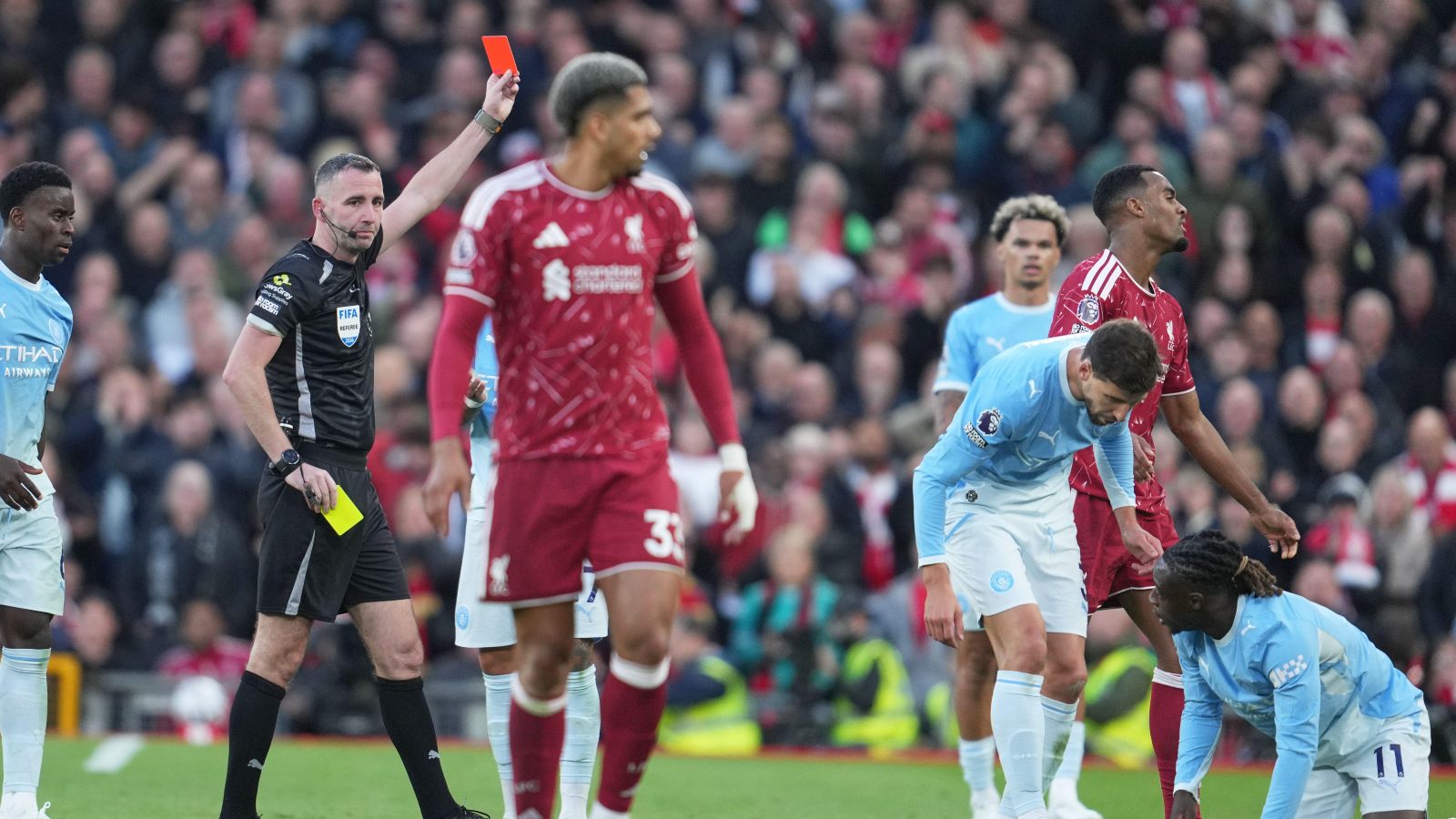
Roy Keane has reportedly launched a furious criticism of the officiating after Ryan Gravenberch was sent off during Liverpool’s Premier League clash against Manchester City, with the midfielder’s dismissal becoming a major talking point in the contest.
Gravenberch received a second yellow card in the 62nd minute following a challenge on Jérémy Doku in City’s half, leaving Liverpool with 10 men at Anfield. The decision came at a crucial stage of the game and shifted the balance in favour of Pep Guardiola’s side.
The supplied comments attributed to Keane suggest the former Manchester United captain was particularly unhappy with the referee’s decision, arguing that the punishment was excessive given the circumstances of the match.
“Listen, I’m sitting here absolutely flabbergasted by what I’ve just witnessed. We are talking about Liverpool versus Manchester City at Anfield,” revealed Keane.
“This isn’t a pre-season kick-around, this isn’t a mid-table dead-rubber—this is as big as it gets in world football. You’ve got millions watching around the globe, two top-class teams going toe-to-toe, and the entire match gets ruined because the officials want to be the main event.
“Look at the match context! Ryan Gravenberch was having one of his absolute best games in a Liverpool shirt. He’s driving through the midfield, he’s testing Gianluigi Donnarumma with a cracking strike from range, and then literally seconds later, he makes a recovery challenge in the City half on Jérémy Doku.
“Was it a foul? Yeah, fine, give a free-kick. But to whip out a second yellow card in the 62nd minute for that? It is an absolute disgrace.
“The first yellow card early in the second half was soft enough as it was, but to issue a second yellow—effectively killing the entire spectacle—requires a level of common sense and match management that these referees simply don’t possess right now. Where is the game management?
“Where is the understanding of what is at stake? Referee Chris Kavanagh couldn’t wait to get his card out. It’s refereeing by a textbook without having a single clue about the emotion, intensity, or context of a massive Premier League fixture.
“You treat a big game like a big game! You let the players fight it out on the pitch. You don’t send a lad off for a minor collision on the halfway line when neither tackle warranted a sending off.
“And what happens? The moment Liverpool go down to ten men, the entire balance shifts. City take complete control, Erling Haaland scores two minutes later, Doku gets another, and the game is done.
“The decision-making from the officials today was shocking. It robs the fans, it robs the players, and frankly, it ruins what should have been an iconic battle. They need to start applying some real football intelligence out there instead of hiding behind harsh whistle-blowing.”
Gravenberch’s dismissal proved pivotal in the match narrative, with Liverpool forced to reorganise defensively and cope with City’s numerical advantage.
The midfielder had reportedly been influential before the incident, contributing to Liverpool’s work in possession and testing City’s goalkeeper from distance. His departure, however, left the hosts facing a significantly more difficult task against opponents renowned for exploiting space and controlling matches.
The reaction attributed to Keane centres on the distinction between applying the rules and managing a high-stakes contest. While referees must enforce the laws of the game consistently, the decision to issue a second yellow card can have an immediate and substantial impact on a team’s chances.
Nevertheless, a second yellow card is a matter of the referee’s interpretation of the challenge and the applicable rules. Without independently verified match footage and confirmation of Keane’s comments, his reported criticism should not be treated as an established assessment of the incident.
For Liverpool, playing with 10 men against Manchester City would make an already demanding contest considerably harder. City’s ability to move the ball quickly and stretch opposition defences means even a small numerical advantage can create opportunities to take control.
The incident also places renewed focus on discipline in matches where the margins are tight. Players must balance the need to recover possession with the risk of committing another bookable offence, particularly after receiving an earlier yellow card.
Gravenberch’s red card may therefore remain one of the defining moments of the encounter, but the debate surrounding it ultimately depends on the precise nature of the challenge and the referee’s decision.

Toosin is a dedicated sports writer with a strong background in crafting engaging and insightful content. With experience at Goal, he has developed a sharp editorial sense and a refined storytelling approach that brings depth and perspective to sports journalism. His passion for the game goes beyond the headlines, as he captures both the excitement of the sport and the compelling human narratives behind each event. Toosin’s work resonates with a broad and diverse audience, making global sports stories accessible, relatable, and impactful.